Tuesday, February 16, 2016

Ein Karem


We began the day in the small village of Ein Karem (which means “Spring of the Vineyard.”) One of my Palestinian students from UTC has family who live here, and this is where St. John the Baptist was born.  According to the Bible, Mary “traveled quickly into the hill country, to a city of Judah,” where she visited her cousin Elizabeth (who was pregnant with John the Baptist) and her husband Zechariah. We visited the Church of St. John the Baptist which is believed to have been built above the remains of ancient mosaic floor and cave where John was believed to have been born.
After spending some time in this Church (which is maintained by the Franciscans with financial support from Spain), we passed the Spring of Mary along the way to our climb up to the Church of the Visitation. The ancient sanctuary in the Church of the Visitation is built on the site that was believed to be St. John the Baptist’s parents’ summer home where Mary visited them. It is built around a large rock known as “the stone in which John was concealed.” As the story goes, King Herod (who had heard a new King of Jews was to born) had heard about John’s unusual birth, so Herod wanted John killed for fear that he might be the new King. His parents planned to flee to Egypt so John would not be killed, but when Elizabeth saw soldiers pursing them, she begged God to help them escape. Reportedly, she hid baby John behind a rock, and the sun reflected off the rock so brightly that the soldiers were temporarily blinded, and John and his family were able to flee, thus saving him from death. The sanctuary of the Church of the Visitation is built around this rock.
After this stunning adventure we moved on the Israel Museum. Among the really fantastic things we were fortunate to see here were the Venus Berekhat Ram, which is a carved female figurine that is believed to be the oldest artwork in the world. The museum also houses the Shrine of the Book, which is home to the Dead Sea Scrolls. We also got to see some of the clay jars in which the scrolls were found.

After lunch at the museum, we moved onto the Church of All Nations, which is also known as the Basilica of the Agony on the Mount of Olives. It is believed to enshrine the bedrock on which Jesus is believed to have prayed before his arrest. Monsignor Al and Father Rich celebrated Mass with us on the altar as we all gathered around this “Rock of the Agony.” After Mass, Tony put his foot on the rock as we said a prayer for healing together. It was amazing to listen as Father Rich spoke the Eucharistic Prayer and got to the line “At the time he was betrayed and entered willingly into his Passion,” I got chills realizing that Jesus was betrayed on or near the rock right in front of us!  It is called the Church of all Nations because many countries helped contribute to his design and its construction, including: Argentina, Brazil, Chile, Mexico, Italy, Spain, France, Belgium, Canada, Germany, Hungary, Poland, Ireland, Australia, the US and the UK.

After Mass, we moved across the street for some prayer time in the Garden of Gethsemane. This is the garden at the foot of the Mount of Olives where Jesus prayed and his disciples slept the night before after his arrest. Gethsemane is the garden where the Virgin Mary was buried and was assumed into Heaven after her domition (“falling asleep”) on Mount Zion. One of the olive trees in the garden looked like it was offering me a loving hug. As a few of us were waiting to leave the garden, we got to watch a herd of goats run down the street followed by a car playing rap music. It was quite a juxtaposition!

After a long day of walking in the hot sun on a beautiful day, we came back to the King’s Palace (out quaint little guest house in the Old City) for dinner. All the food here is hearty and delicious. Dinner was followed by a presentation by Catholic Relief Services, and they discussed some of their humanitarian work in the region.

Sunday, February 14, 2016

Off to Israel

We are leaving Chattanooga to make our Lenten pilgrimage to Israel. As you can see, Ella and Red are not too happy about being left behind to guard the house. They will have several human companions looking out for them and helping them guard the homestead.

Friday, May 23, 2014

Barcelona


The late Freddie Mercury had a song called “Barcelona,” which included these lyrics:

Barcelona! It was the first time that we met
Barcelona! How can I forget
The moment that you stepped into the room
You took my breath away

While Barcelona has not necessarily taken my breath away, some of the sights that Tony and I have experienced the past few days have definitely blown me away.  Our first full day here, we toured the Basilica of the Sacrada Familia (the Basilica of the Holy Family).  The fantastical building has been under construction since 1882, and it is not expected to be completed until 2026.  The Basilica was designed by Antoni Gaudi, and there are no words to adequately describe it.  When it is completed, it will have 18 towers – 12 for the apostles, 4 for the evangelists, 1 for the Virgin Mary and 1 for Jesus.  Currently, there are only 8 towers.


Tony and I spent much of yesterday in the Las Ramblas area.  Despite its reputation for being full of pickpockets and gypsies trying to scam tourists, we never saw even a hint of trouble.  We visited the Cathedral of Barcelona, which is an amazing Gothic church.

After the Cathedral, we spent several hours in the Museu de Frederic Mares.  Frederic Mares was a wealthy Catalan sculptor who lived to be almost 100 years old.  He once claimed that he created sculptures so that he would have the money to collect sculptures.  That said, however, he collected far more.  He collected sculptures, paintings, pipes, bed warmers, armor, guns, eyewear, binoculars, photography equipment, time pieces, table silver, tobacco jars, boxes, books, life-sized Crucifixes, and more!  Even after hours in the museum of his collections, we never saw everything.  It was fascinating.   
We also visited the section of Las Ramblas where George Orwell once lived.  We found it ironic that the the area where Orwell (the author of 1984, among other books) once lived is now monitored 24/7 by a security camera.  Very rich, indeed.

 Then we finally broke down and went to lunch at a place where I could eat an American hamburger.  I will confess that I am normally pretty culinarily adventurous (something I learned from my friend, Ginny Love), but I was seriously craving a good old American hamburger yesterday.  I was able to get one (with excellent onion rings!), and I was one happy girl!  We also found a Metro stop with my name on it!!!
Today, we started the day with a visit to the Museu de le Xocolata (Museum of Chocolate).  This place tells about the history of chocolate.  Chocolate came to be revered in Mesoamerican culture. According to ancient Aztec legend, the cacao tree was brought to Earth by the god Quetzalcoatl, who descended from heaven on the beam of a morning star after stealing the precious plant from paradise. It’s no wonder that the spicy beverage made from its beans was called the ‘Drink of the Emperor.’ It is said that this xocoatl or chocolatl was so revered that it was served in golden goblets that were thrown away after one use.

Chocolate was served during religious rites and celebrations. It was often mixed with flavorings such as vanilla, cinnamon, allspice, chilis, hueinacaztli—a spicy flower from the custard apple tree—and anchiote, which turns the mouth bright red. The Aztec also believed that cacao possessed strong medicinal properties—indeed, warriors were issued solid cacao wafers to fortify their strength and endurance for long marches and the rigors of battle.

There were lots of amazing things in the museum built out of chocolate.  The museum is pretty effective, though, because one walks through and looks at all of these things built out of chocolate, then one craves chocolate, and the exit pours into a store filled with CHOCOLATES!!! Tony and I played right into their hands.  It was delightful.


After we made our selections of chocolates (which was no easy task!), we ambled back to Las Ramblas.  We stopped for a quick bite, and I had a tapas dish of Iberian ham while Tony had apple pie and wine.  During our lunch we watched a group (perhaps a labor group?) engage in some sort of very loud protest right outside of our restaurant.  We are seeing a lot of protests pretty much everywhere we go.  

Once we finished eating, we headed down to Museu de l’Erotica (Museum of Erotica).  Tony had more desire to sit out in the sun than to go into the Museum, so I went alone.  It was interesting, and actually humorous at moments.  They showed a vintage porn film from about 90 years ago.  I am NOT into porn and never have been, but I admit I was curious about porn from 90 years ago.  I watched a few minutes of it, and it was hilarious.  Everything that happened occurred with clothes on, and would probably be considered PG-13 by today’s standards.  But, it was porn 90 years ago.  Priceless.  Many of the rooms in the museum illustrated the history of erotica in other cultures – China, Japan, Egypt, India, Europe, Russia – and included artwork and manuscripts of historic value. 
 Tony and I have not managed to do as much “touristy” stuff as many of the others on the trip because we have had to come back to the room most days and do some work.  For us, this is sort of working trip, and we are both having to keep in touch with work.  So be it. We are terribly excited that we will see our babies  -- Ella and Red – in less than 36 hours.  We miss them so much.

As for a short summary of our impressions of Spain, I will try and share them here.

What we like about Spain:

1.      I love that so many public spaces (esp. subway stations) have random people playing music.
2.      The people here are generally very friendly.  Even my Italian husband says the people here are very nice and “not jerks like the people in Italy and Greece.” So, there you go.
3.      Tony likes the cheap wine and the tapas.
4.      I think the subway in Barcelona is one of the best I have seen.
5.      I love that there is so much Catholic culture in Spain, and especially Barcelona.

What I don’t love so much about Spain:

1.      While Tony likes the tapas, I do not care too much for the food. 
2.      The Madrid Airport is dreadful.  This trip involved my third experience with the Madrid Airport, and I have hated it every time.
3.      Tony has found it virtually impossible to find American-style coffee unless he goes to a Starbucks.  Even at breakfast, he is stuck with espresso or cappuccino.
4.      Heaven forbid a Western tourist should want to eat dinner at any time before 9pm because many places won’t open for dinner until freakin’ 9pm!  What the hell??? I mean, I totally get that Spaniards don’t eat dinner until 9pm, but in areas where there are loads of tourists, why don’t places bother to open a little earlier?  I am flummoxed as to why this is.
5.      As a wife, it blows my mind that so many Spanish women don’t wear underpants.  They get on the subway in their tiny little dresses, and when trains BLOW into the stations, their dresses blow up, and they flash their naked butts to my husband.  I wish you could have seen Tony’s face the first time it happened.  I almost fell over laughing, but it doesn’t mean I like it.
6.      When you go to restaurants, you often have to choose between sitting inside where the temperature is equivalent to one of my hot flashes, or sit outside where everyone is smoking.  Either choice sucks, IMHO.

So, in summary, I am glad we have had the chance to see Spain, but having made two trips to Spain in my lifetime, I am not sure I would ever want to return.  If Brittain, Alex, Melody, Kayla and all my other friends who LOVE Spain read this and hate me for not loving Spain, I sincerely apologize. I swear I came with an open mind, but I guess Spain’s charms are lost on me. 

Joanie

Monday, May 19, 2014

Cordoba and Granada


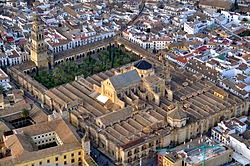
We left Sevilla at 8am for a short drive to Cordoba where we toured The Great Mezquita (The Great Mosque) – Cathedral of the Assumption of Our Lady.  If you are confused, that is understandable.  Groundbreaking for the original mosque (most of which is still standing) was in 784, and it was completed in 987 – just over 200 years.  The building was originally a medieval mosque with a rectangular hall that had aisles that were perpendicular to the normal direction in which Muslims were accustomed to praying.  The Muslims who led the construction of the mosque were said to be very conciliatory towards the Christians of Cordoba.  They used and valued the skills, crafts and artwork of many Christians in the construction of the mosque.  
When King Ferdinand III of Castille conquered Cordoba in 1236, the mosque was consecrated as a Catholic Cathedral.  Future kings added other Catholic additions including a Cathedral nave (main body of the church which provides a central approach to the high altar), and multiple chapels (including chapels honoring my confirmation saint, St. Theresa and Tony’s patron saint, St. Anthony).  Nothing I could write here cold do this place justice.  Essentially, this is an enormous Catholic Cathedral built within a ginormous Muslim Mosque.  Just fantastic to experience.  Truly.
After our tour, we encountered some protesters.  Apparently, for the past 14 years, Spanish Muslims have lobbied the Roman Catholic Church to allow them to pray in the Cathedral of the Assumption of Our Lady.  This Muslim campaign has been rejected on multiple occasions, by both Spanish Catholic authorities, and the Vatican.  Nevertheless, the protests continue.

Then we had lunch at a local restaurant.  I am still not sure what our first course was.  It was some sort of cold soup.  I suspect it was some sort of vegetable puree in which we put small bits of chopped cucumbers, chopped scallions and croutons.  The soup was red, but it was not tomato.   It was tasty, but I am still not sure what it was.  Next we got some fried things served with mayonnaise.  Some in the group think it was fried potatoes.  Again, I am not convinced.  I think it might have been fried eggplant.  I declined the pie, but Tony says it tasted “fruity.”  Who knows?

Then we left Cordoba for Granada. 

When we arrived in Granada, it was blessedly cooler.  Of course, we got into the hotel, and it was filled with obnoxious children who were obviously high on sugar and caffeine blowing whistles and being as annoying as possible while their parents got drunk.  Nice.
This morning we enjoyed a fabulous breakfast for heading out to visit to the Alhambra.  The Alhambra’s Islamic Palaces were built for the last Muslim emirs (princes) in Spain. I have tried to include some photos of the palace and the gardens, but nothing here shows the true splendor of this place.  


Tomorrow, we leave Granada for Barcelona, the final city on our trip.  I will do my best to keep you all posted.

Joanie